
Slab leak water damage in Pearland
A pipe breaks under the slab, and fixing it right takes two separate calls.
Get Help Now(281) 915-182224/7 emergency line. Free estimates from local pros.
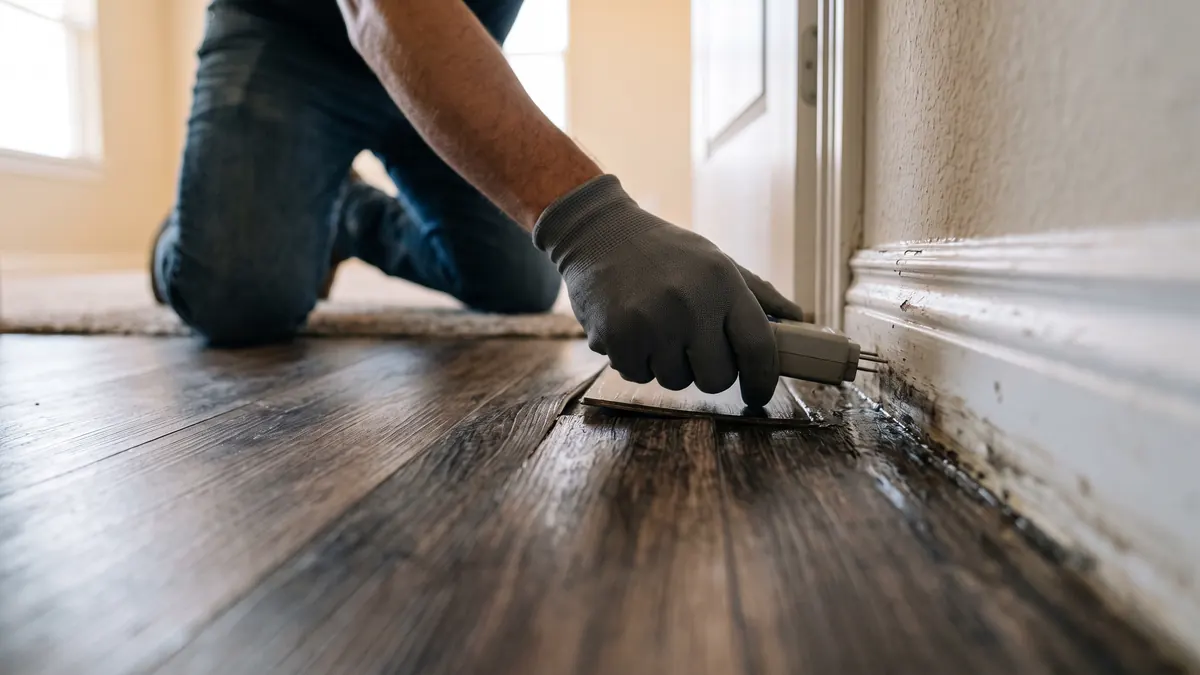
A slab leak is a broken water line running under your home’s concrete foundation. Fixing it right takes two different calls: a leak-detection or plumbing company to find and stop the leak, and a restoration company to dry out and repair what the water reached. We’re the second half of that. Call us and we get a local crew moving on the drying and repair side, while you line up the plumbing side on your own.
Why this job needs two companies
A plumber’s tools find and stop a broken pipe. They aren’t built to pull water out of a soaked subfloor or dry damp insulation inside a wall. A restoration crew handles the drying and repair, but it can’t do anything about water that’s still leaking under your slab right now. Most Pearland slab leaks need both companies working the problem from two directions. Line up the plumbing side as soon as you notice a sign, and call us for the drying and repair side. Waiting to finish one before starting the other usually costs you time you don’t get back: a plumber who’s already stopped the leak doesn’t need the area dry first, and a restoration crew can often start moisture mapping and setting equipment while the pipe repair itself is still getting scheduled.
Signs worth checking today
One of the more common tells is a floor that runs warm or damp in a single patch while staying cool everywhere else, especially over a hot-water line. Your water meter can also tell you something useful: shut off every faucet and appliance in the house, then watch the dial. If it’s still turning, water is going somewhere it shouldn’t. A water bill that jumps with no obvious reason, no new appliance, no extra houseguests, is another flag worth a second look. Some homeowners hear it before they see anything at all: a low hiss under the floor in a quiet room, water moving where no tap is on. A room that feels a little more humid than the rest of the house, or tile that stays warm underfoot even with the heat off, can be a quieter version of the same signal. None of these alone proves a slab leak. Together, two or three of them are worth a call.
How it gets found without tearing up the whole floor
Detection comes before demolition, not after. Plumbers who specialize in leak detection use listening equipment that picks up the sound of pressurized water escaping underground, along with thermal imaging that spots the warm patch a hot-water leak leaves on the surface above it. Some jobs also get pressure-tested section by section to isolate which line is losing water. The slab leak signs guide helps you read the signs before you ever see a puddle, which is the cheapest way to catch one of these leaks while it’s still small. Once the leak is pinpointed, the fix might be a small access hole through the slab, or a tunnel dug from an exterior wall that avoids cutting the floor at all. Which one depends on where the pipe runs and how the plumber can get to it.
What’s worth writing down before anyone starts cutting
Take a few photos before either company gets to work: the warm spot on the floor, the water meter reading, any stain or damage that’s already visible. A timestamped photo holds up better than a memory once work starts and the area under discussion no longer looks the way it did last week. Both the plumber and the restoration crew will ask what you noticed and when, so a short written timeline, even just a note on your phone, saves you from guessing later. If your policy ends up part of the conversation, that same record is close to what an adjuster will want to see too.
What Pearland’s clay soil has to do with it
Pearland sits on the same Gulf Coast clay found across most of the Houston region, part of the Beaumont geological formation. The Houston Black soil series, one of the more expansive clay types in this part of Texas, was first classified in Brazoria County itself, back in 1902, the same county most of Pearland sits in. That clay swells when it soaks up water and shrinks back down when it dries out, and that cycle puts real stress on slab foundations and on the pipes running underneath them. It’s a general reason slab leaks turn up across this part of Texas more than in a lot of other places, not a sign that any one yard or street in Pearland has it worse than another.
Construction era changes the odds, not the outcome
Older parts of Pearland carry more risk on paper. Green Tee Terrace, which broke ground in 1970, sits in the era when copper supply lines under the slab were standard. Newer areas like Shadow Creek Ranch were built well into the PEX era, and PEX tends to behave differently underground than copper does over the same stretch of years. Even Old Townsite, Pearland’s oldest neighborhood, has new PEX-plumbed homes going up on old lots as part of the area’s recent infill building. Pearland’s growth adds another wrinkle: the city went from about 37,640 people in 2000 to more than 91,000 by 2010, one of the fastest stretches of growth anywhere in the Houston area that decade, and a lot of that building pushed west toward Shadow Creek Ranch and its PEX-era plumbing. A bigger share of the market sits on newer pipe than in a lot of nearby suburbs because of it. PEX shifts the odds in your favor without retiring the risk: the clay working underneath every slab in this market doesn’t care what the pipe is made of.
What the adjuster really wants to know
Insurance tends to treat a slab leak differently depending on how long it was running before anyone found it. A sudden pipe failure reads one way to most adjusters; a leak that had been weeping for months before it surfaced can read another way. Slab leaks usually land in the second bucket, since it often takes weeks or longer before a warm spot or a meter reading gives one away. That’s exactly why the adjuster’s first question is rarely about the pipe itself and almost always about the timeline. That answer is always specific to your policy, so this isn’t a claim we can settle in general terms. For what to write down and when, see the water damage insurance claim guide for the timing that matters most.
Slabs don’t leak loudly. A puddle in the yard or a stain on the ceiling below usually means water’s been moving under the house for a while already. Check the signs on the floor’s schedule, not the calendar’s, whether that floor sits over Green Tee Terrace’s older lines or a newer stretch of Shadow Creek Ranch. Once the leak’s fixed and the area’s dry, water damage repair gets specific about what actually gets replaced versus repaired. Call us, and the drying side starts moving while the plumber is still on the way.
Common questions
Does homeowners insurance cover a slab leak?
It depends on your policy and how long the leak ran before it was found. A sudden pipe failure and a leak that's been weeping for months often get treated differently by an adjuster. Check your policy wording directly, and keep photos and receipts either way.
Will they jackhammer my floor, or can they tunnel under it?
It depends on where the pipe sits and how the plumber can reach it. Some jobs open a small access point through the slab. Others tunnel underneath from an exterior wall or a cleanout, which avoids cutting the floor at all. The plumber decides based on the leak's location, not a one-size answer.
How do plumbers find a slab leak before any digging starts?
Most start with listening equipment that picks up the sound of water escaping under pressure, plus thermal imaging to spot a warm patch over a hot-water line. Some also pressure-test the system section by section. The goal is narrowing the leak down to a small area before anyone cuts into concrete.
Do I call a plumber first, or the restoration line?
Either order works, but don't wait on one to start the other. A leak-detection plumber finds and stops the leak. We get a local restoration crew moving on drying out and repairing what the water already reached, and that clock is running the whole time the pipe is still leaking.
Related pages
Appliance Leak Cleanup
The appliances that use water are also the ones most likely to flood a room without any warning at all.
Learn more →Burst pipe
Stop the water first. What it did to your walls and floors is the next call.
Learn more →Ceiling Water Damage
What the mark on your ceiling actually means, and why some of them mean stop looking and back away.
Learn more →Commercial Water Damage
Water found before the doors open sets off a different chain of calls than water found at home.
Learn more →Talk to a local pro now
We answer 24/7. One call gets a Pearland crew moving on your water damage, with a free estimate and help with your insurance claim.
Get Help Now(281) 915-1822Free estimates. No obligation to hire.